
Slow-Moving Inventory Needs a Different Decision, Not Just a Lower Forecast
Jun 24
/
JB McDaniels - SCM Learning Center
When an item starts moving slowly, the common response is simple: lower the forecast.
That may feel logical, but it is often incomplete. A lower forecast only changes the expected future demand signal. It does not answer the larger operational question:
Should we keep replenishing this item, control it differently, burn it down, reposition it, or dispose of it?
That is the decision many teams avoid.
Slow-moving inventory is not one problem. It may be a healthy low-volume item, an intermittent-demand item, a lifecycle decline item, a service-critical spare, a customer-specific leftover, a seasonal carryover, or stock that is already economically obsolete.
The first question should not be, “What should the forecast be?”
The first question should be, “What type of slow-moving inventory is this?”
Until the item is classified, the forecast change is only a partial adjustment.
Why This Matters
Inventory that does not move still consumes working capital, space, handling effort, system attention, and management time. It also creates a false sense of available value. The item may still appear as an asset in the system, but operationally it may be hard to sell, hard to use, or unlikely to convert back into cash.
That is why slow-moving inventory needs a decision process, not just a forecast adjustment.
A forecast answers, “How much demand do we expect?”
A slow-moving inventory decision answers, “What should we do with the inventory we already have, and should we keep replenishing it?”
Those are different questions.
Where Teams Get Misled
The biggest mistake is assuming that slow movement automatically means the forecast is too high.
Sometimes it is. But often, the issue sits somewhere else:
* The product is entering decline or end-of-life.
* Demand is intermittent, not truly disappearing.
* Minimum order quantities keep adding supply after demand slows.
* Safety stock settings were never adjusted.
* The item is customer-specific and has no broad market.
* The stock is aging physically, commercially, or financially.
* The warehouse still holds inventory that the market has already moved past.
Lowering the forecast without changing the inventory policy leaves the replenishment engine running slower, but still running.
That is not control. It is delayed accumulation with a cleaner forecast.
Operational Trap 1: Treating Slow-Moving Items Like Normal Replenishment Items
Many slow-moving items remain in the same planning logic as active, stable-demand items. They keep reorder points, safety stock targets, preferred supplier settings, minimum order quantities, and automatic replenishment parameters.
That creates a quiet problem. The system continues to buy or produce, even though the item now requires a different control method.
Example:
A spare part sells only three or four times per year, but the system still carries a reorder point based on old demand history. Each time inventory drops below the trigger, another purchase order is released. The planner lowers the forecast, but the reorder policy still protects stock as if the item is active. Over time, the company creates more inventory than the demand pattern can absorb.
Better decision:
Move the item from automatic replenishment to controlled replenishment. Use planner review, minimum/maximum controls, service-critical logic, or “buy only against approved demand” rules.
Operational Trap 2: Confusing Intermittent Demand With Dead Demand
Some slow movers are not dead. They are intermittent.
Intermittent demand means the item may have long periods of zero demand followed by occasional demand spikes. That behavior is common in spare parts, replacement components, industrial supplies, maintenance items, and specialty SKUs. Traditional forecasting methods can misread this pattern because repeated zero periods may look like decline, even when future demand still exists.
Example:
A maintenance component has no demand for five months and then receives one large order from a plant shutdown project. If the item is treated as dead, the company may dispose of stock too early and then face an urgent shortage. If it is treated as a normal item, the company may overstock it. Neither approach is good.
Better decision:
Classify the demand behavior before changing the policy. Ask whether demand is stable, intermittent, lumpy, declining, dormant, or truly obsolete. Different patterns require different planning controls.
Operational Trap 3: Ignoring Lifecycle Stage
Inventory decisions should change as the product moves through its lifecycle.
A new product, growing product, mature product, declining product, and end-of-life product should not all use the same planning assumptions. Slow movement during launch may be a market adoption issue. Slow movement during maturity may be a normal low-volume pattern. Slow movement during decline may be an obsolescence warning. Slow movement after replacement or phase-out may require formal disposition.
Example:
A distributor launches a new version of a product but leaves the older version active in the system. Demand shifts to the new item, but the old item still has reorder parameters. The forecast slowly drops, but purchase orders continue because no one formally changed the lifecycle status. Six months later, the old item becomes excess stock.
Better decision:
Tie inventory policy to lifecycle stage. When a product enters decline, planning should shift from “protect availability” to “control exposure.” When it enters end-of-life, the decision should shift again to “harvest, substitute, return, liquidate, donate, scrap, or write off.”
Lifecycle Stage Should Change Inventory Policy
Lifecycle status should not be a label buried in the item master. It should drive the inventory policy.
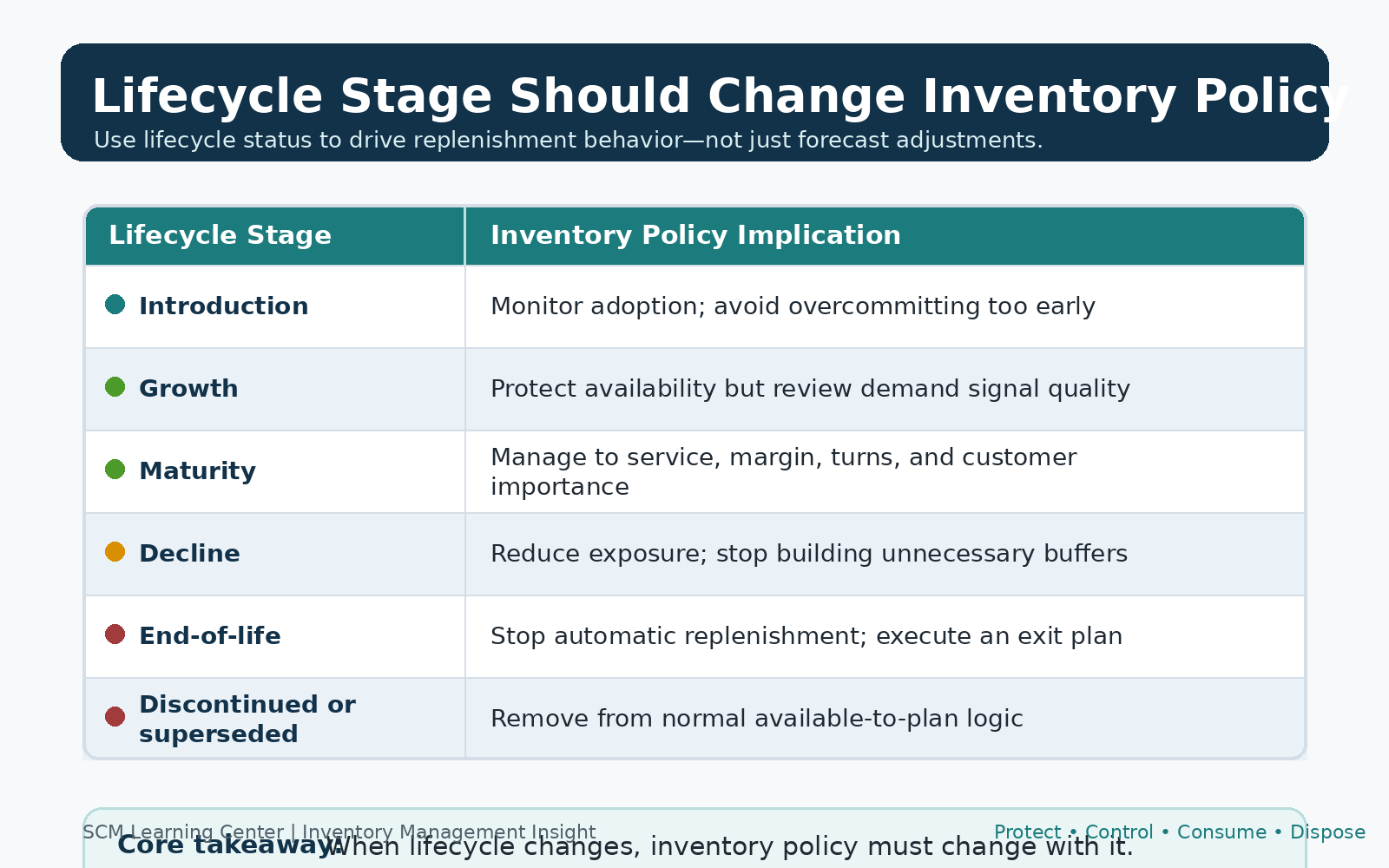
This is where many organizations fall short. The product lifecycle changes, but the inventory policy stays frozen in the past.
When that happens, the planning system continues to make old decisions for a new reality.
The Better Decision Framework: Protect, Control, Consume, or Dispose
Slow-moving inventory should be classified before the forecast is reduced. The decision should follow the item’s role, demand behavior, lifecycle stage, and remaining economic value.
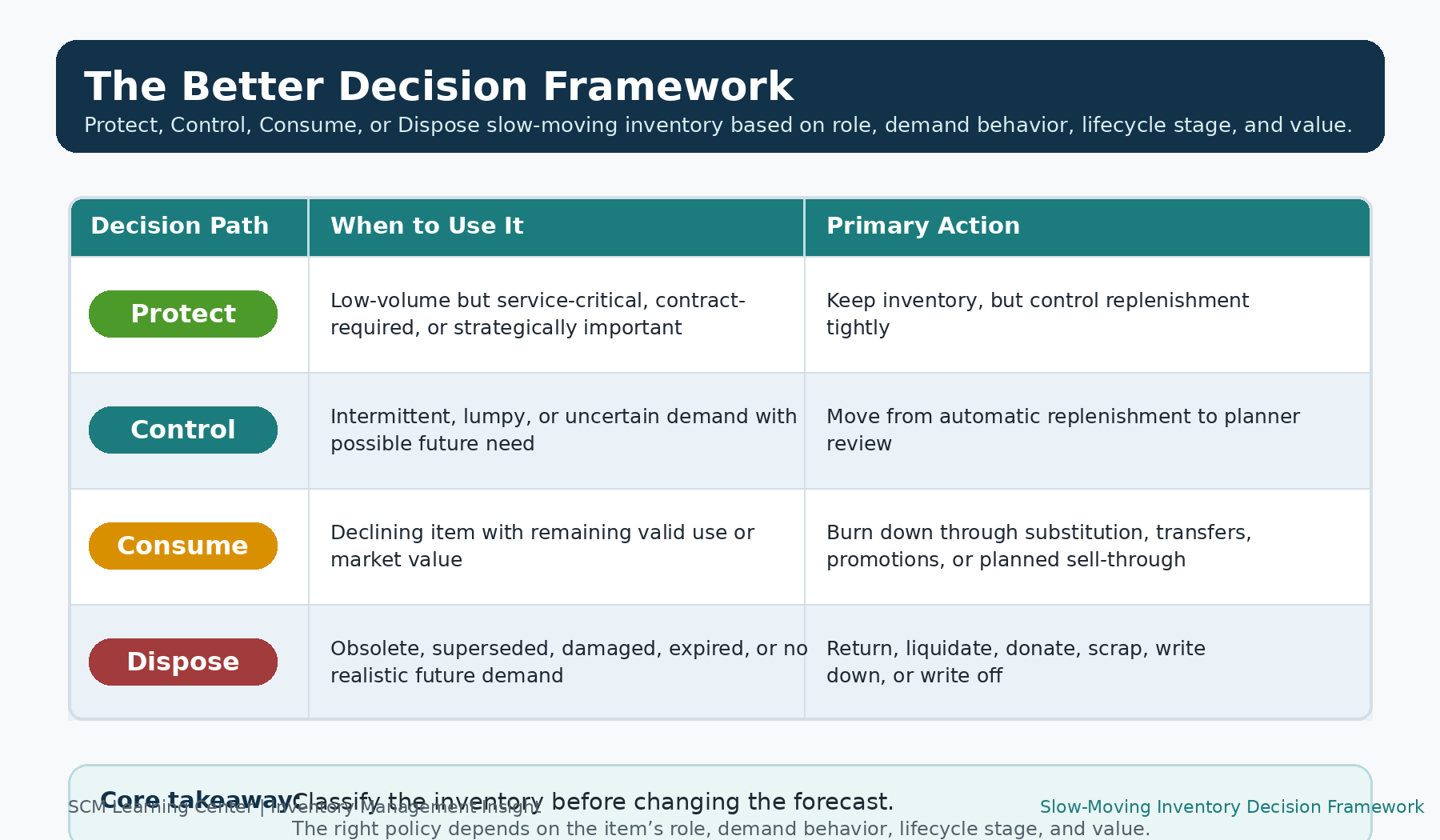
This model prevents two common mistakes.
First, it prevents teams from disposing of every slow mover too aggressively. Some slow-moving items still protect service.
Second, it prevents teams from protecting every slow mover like an active item. Some slow-moving items should stop receiving replenishment immediately.
One caution: slow-moving does not automatically mean bad inventory. Some low-volume items protect service, uptime, contractual commitments, or customer trust. The mistake is not holding slow-moving inventory. The mistake is holding it without a clear decision, policy, and owner.
The point is not to punish slow movement. The point is to choose the correct decision path.
A Simple Decision Reminder
This is the practical shift: slow-moving inventory should move out of default planning logic and into intentional decision logic.
Four Decision Lenses for Slow-Moving Inventory
1. Lifecycle Status
Ask where the item is in its lifecycle:
* Introduction
* Growth
* Maturity
* Decline
* End-of-life
* Discontinued
* Replaced or superseded
Decision example:
If the item is mature but low volume, keep it under controlled replenishment. If the item is declining, reduce exposure. If it is end-of-life, stop automatic replenishment and build a disposition plan.
2. Demand Behavior
Ask how demand actually behaves:
* Stable low volume
* Intermittent
* Lumpy
* Seasonal
* Project-based
* Customer-specific
* Declining
* Dormant
* Dead
Decision example:
A stable low-volume item may still deserve inventory. A lumpy project item may require make-to-order or buy-to-order planning. A dormant item may require commercial review before it is counted as useful stock.
3. Inventory Aging and Risk
Ask how old the inventory is and what kind of aging risk exists:
* Days since last movement
* Months of supply on hand
* Shelf-life or expiration risk
* Engineering revision risk
* Packaging or labeling risk
* Customer or market relevance
* Substitute availability
* Carrying cost and warehouse burden
* Financial write-down exposure
The threshold should not be universal. A 180-day no-demand trigger may be too slow for seasonal consumer goods and too aggressive for critical spare parts. The trigger should reflect item role, shelf life, demand pattern, lead time, service requirement, and financial exposure.
Accounting standards focus attention on whether inventory is still recoverable at expected selling value. Operational teams do not need to become accountants, but they do need to flag inventory whose market value or utility is no longer supportable.
Accounting standards focus attention on whether inventory is still recoverable at expected selling value. Operational teams do not need to become accountants, but they do need to flag inventory whose market value or utility is no longer supportable.
Decision example:
A slow-moving item with 18 months of supply, no recent demand, and a newer replacement item should not sit in normal available inventory. It should be flagged for disposition review.
4. Disposition Path
Ask what action should be taken:
* Keep and control
* Reposition to another location
* Substitute against future demand
* Return to supplier
* Bundle or promote
* Discount or liquidate
* Rework or relabel
* Donate
* Scrap
* Write down or write off
Decision example:
If there is still commercial value, sell-through or liquidation may recover cash. If there is internal use, substitution may reduce future purchases. If there is no realistic use or market, holding the item only delays the loss.
A Practical Slow-Mover Decision Matrix
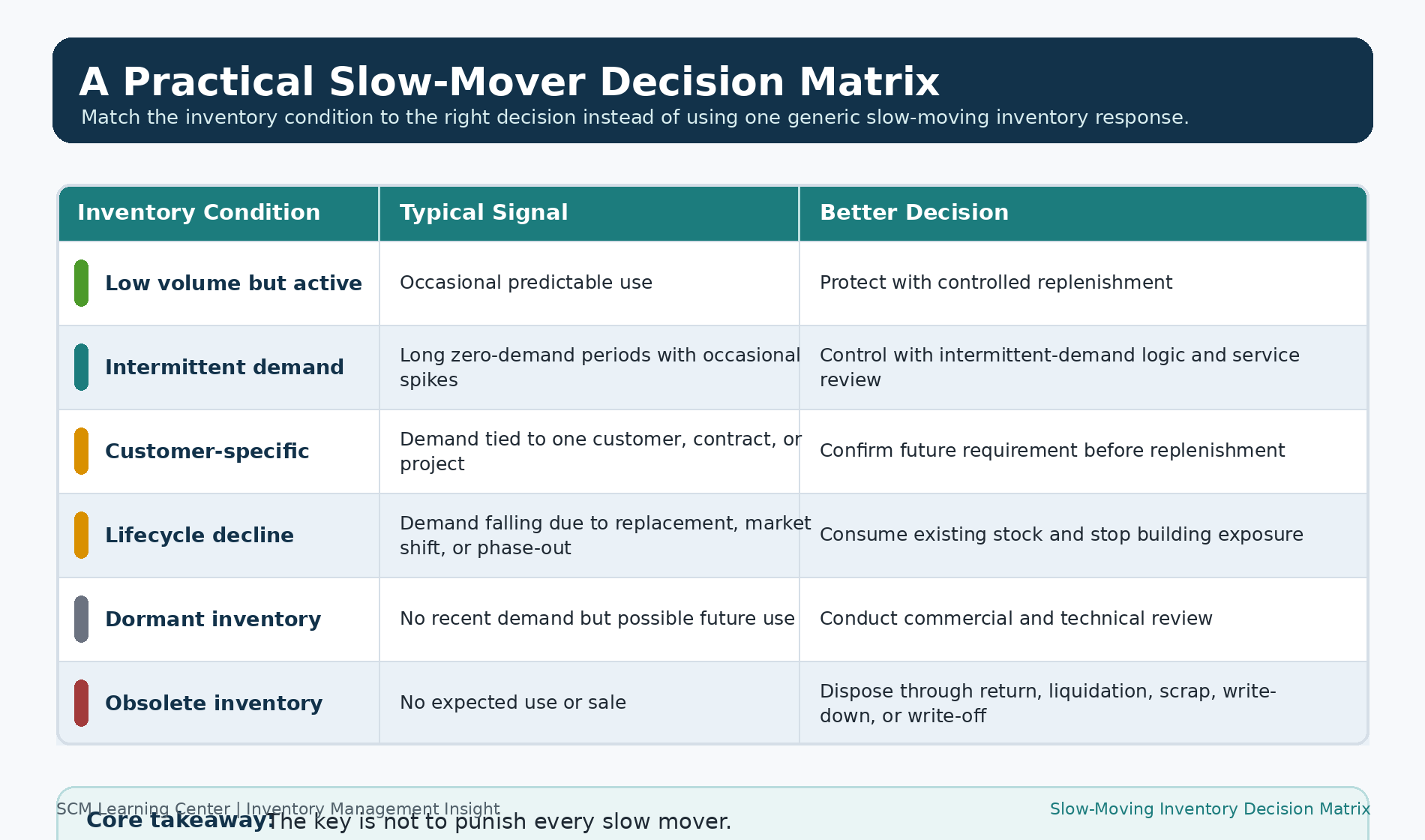
This is one of the main reasons slow-moving inventory lingers. Planning sees the signal. Sales owns the customer conversation. Product management owns lifecycle direction. Procurement owns supplier options. Warehouse operations feels the space problem. Finance sees the valuation risk.
Slow-moving inventory often stays stuck because everyone touches the problem, but no one owns the decision.
Diagnostic Questions for Planners and Managers
Use these questions before lowering the forecast:
1. Is this item slow-moving because demand is low, intermittent, declining, or gone?
2. Is the product still active, declining, replaced, discontinued, or end-of-life?
3. Is there a customer, contract, service requirement, or regulatory reason to keep stock?
4. Are replenishment parameters still active even though demand has changed?
5. Does the item still have realistic market value?
6. Is there another location, customer, product, or internal use that can consume the stock?
7. What is the cost of holding it versus the expected recovery value?
8. Is the item occupying space needed for faster-moving or higher-priority inventory?
9. Who owns the disposition decision: planning, sales, finance, product management, procurement, or operations?
The last question matters. Without ownership, slow-moving inventory becomes a recurring review topic instead of a resolved decision.
Actions Teams Can Take Now
1. Identify
Pull slow-moving inventory using practical triggers such as no demand, high months of supply, aging inventory, shelf-life exposure, lifecycle status, or replacement status.
Example:
A planning team reviews all items with no demand in 180 days, more than 12 months of supply, or a lifecycle status of decline. The thresholds are adjusted by item type because a critical spare part and a seasonal finished good should not use the same trigger.
2. Classify
Assign each item to one of four decision paths: protect, control, consume, or dispose.
Example:
A low-volume but contract-required service part is classified as Protect. An item with occasional demand spikes is classified as Control. A replaced SKU with remaining sales opportunity is classified as Consume. A superseded item with no expected use is classified as Dispose.
3. Change Policy
A lower forecast should trigger a policy review. It should not be the only action.
Review reorder points, safety stock, minimum order quantities, supplier settings, replenishment status, lifecycle status, and approval rules.
Example:
When the forecast drops by more than a set threshold, the item is automatically reviewed for reorder point, safety stock, MOQ, supplier return options, and lifecycle status. Items in decline, end-of-life, or disposition review are removed from automatic replenishment.
4. Assign Owner
Name the function responsible for the next action. Do not let slow-moving inventory remain everyone’s issue and no one’s responsibility.
Example:
Sales owns customer sell-through options. Product management owns lifecycle status. Procurement owns supplier return and cancellation options. Finance owns reserve and write-down review. Planning owns the inventory policy change.
5. Track Closure
Review open slow-mover actions monthly until each item is resolved or reclassified.
Example:
A monthly planning meeting includes a simple status field for each slow-moving item: protect, control, consume, or dispose. That status drives whether the item can be replenished, transferred, promoted, substituted, or removed from active planning.
Short Case: The Forecast Was Lower, But Inventory Kept Growing
A mid-sized industrial distributor noticed that several hundred SKUs had moved into slow-moving status. The planning team lowered the forecasts. Six months later, inventory value was still growing.
The root cause was not only forecasting. Many items still had active reorder points, supplier minimum order quantities, and safety stock settings. Some SKUs were tied to discontinued customer programs. Others were intermittent-demand service parts. A few had replacement items already active in the catalog.
The warehouse team also reported that slow-moving SKUs were occupying forward-pick and reserve locations needed for active products. Finance flagged the same items for potential reserve exposure. What looked like a planning clean-up issue became a working capital, space utilization, and service execution issue.
The real cost was not only the inventory value on the balance sheet. It was the space, handling, planning attention, and missed opportunity to use that capacity for active items.
The company changed the process. Slow movers were segmented into four groups:
* Protect: low-volume but active items with valid service need
* Control: intermittent items requiring planner review
* Consume: declining items to sell down, substitute, transfer, or use internally
* Dispose: obsolete or no-value items requiring liquidation, return, scrap, write-down, or write-off
The result was a better decision process. Planners stopped treating slow movement as only a forecast issue. Sales, product management, procurement, finance, and operations became part of the decision.
That is the real lesson: slow-moving inventory is cross-functional. Forecasting may reveal the issue, but it does not resolve it alone.
Apply the Insight
This week, pull a list of items with no demand in the last 180 days, more than 12 months of supply on hand, or a lifecycle status that signals decline, end-of-life, replacement, or discontinuation.
Do not start by lowering the forecast.
Start by asking:
What decision does this inventory need?
Classify each item into one of four actions:
* Protect
* Control
* Consume
* Dispose
Then review whether replenishment settings still match that decision.
Slow-moving inventory is not automatically bad inventory. But unmanaged slow-moving inventory becomes expensive inventory.
The forecast may tell you demand has slowed.
The inventory decision tells you what to do next.
Sources
ASCM Supply Chain Dictionary / ASCM Body of Knowledge — Inventory Management, Demand Planning, Obsolescence, and Inventory Control Concepts
Used to support professional terminology and inventory management concepts related to slow-moving inventory, obsolete inventory, demand planning, replenishment control, and lifecycle-based inventory decisions.
IFRS Foundation — IAS 2 Inventories / Financial Accounting Standards Board Topic 330 Inventory
Used to support the discussion of inventory valuation risk, net realizable value, write-down exposure, and the financial implications of inventory that may no longer be recoverable at expected value.
Shenstone, L., and Hyndman, R. J. — “Stochastic Models Underlying Croston’s Method for Intermittent Demand Forecasting”
Used to support the distinction between intermittent demand and dead demand, and why items with long zero-demand periods require different planning logic than stable-demand items.
Prepared by
Jeffrey McDaniels
Founder & Chief Capability Officer
SCM Learning Center
www.scmlearningcenter.com
jbmac@scmlearningcenter.com
Copyright © 2025
Created with