Poor inventory accuracy does not stay inside the warehouse. It spreads across the business.
It creates false availability, missed shipments, unnecessary expedites, excess purchases, production interruptions, planning distrust, customer service noise, and labor waste. It also causes managers to add inventory as a protection mechanism, even when the real issue is not too little inventory.
The organization may believe it has an inventory shortage. In reality, it may have an inventory control discipline problem.
Here is the hard truth: if the system says material is available but people cannot find it, the planning system is not reliable. If the system says material is unavailable, but it is physically sitting in a location, the system is also not reliable.
Both conditions damage decision quality.
Inventory accuracy is the foundation for replenishment, service commitments, production scheduling, procurement timing, financial control, and customer trust.
The common assumption is:
“If inventory accuracy is low, we need to count more.”
Sometimes that is partly true. But counting more without fixing the process only increases the frequency of discovering errors. It does not prevent the errors from being created.
A better assumption is:
“If inventory accuracy is low, we need to identify where the process is creating record errors and stop the defect at the source.”
That is a very different management mindset.
Cycle counting should not be treated as an administrative exercise. It should be treated as a process control system. The purpose is not only to correct the record. The purpose is to identify why the record was wrong, where the defect entered the process, and who owns the corrective action.
Managers often confuse the variance with the problem.
The variance is evidence.
The process defect is the problem.
| Term |
Meaning |
Management Question |
| Count Variance |
The difference found during a count |
What does the system say versus what is physically present |
| Accuracy Defect |
The process failure that created the variance |
Where did the record stop matching reality? |
Example
A bin location shows 10 units short. The count variance is minus 10.
But the accuracy defect could be very different:
* The supplier short-shipped the order.
* Receiving posted the wrong quantity.
* A pallet was moved without a system transaction.
* Production consumed material without recording the issue.
* A substitute item was used but the wrong item was relieved.
* A return was placed back into available stock before inspection.
* The item master had the wrong unit of measure.
If the organization only adjusts the record, the immediate count variance is corrected. But if the accuracy defect remains, the same problem will return.
Inventory accuracy improves when managers control the process points where inventory records can become wrong.
1. Receive Right
Receiving is the first major control point. Item, quantity, condition, lot, expiration date, and unit of measure should be verified before inventory is made available for planning, production, or customer orders.
2. Move Right
Every physical move should have a matching system move. If material moves from receiving to staging, staging to storage, storage to forward pick, or reserve to production, the system must move with it.
3. Use Right
Issues, returns, scrap, production consumption, and substitutions must be recorded correctly. If material is used but the wrong item is relieved, the system becomes inaccurate even if the physical operation was completed.
4. Adjust Right
Inventory adjustments should require reason codes, approval rules, and root-cause review. Adjustments correct the record. They do not automatically correct the process.
5. Own Right
Inventory accuracy must have clear ownership by process step. Cross-functional does not mean ownerless. Receiving, warehousing, production, planning, procurement, quality, and finance all influence accuracy in different ways.
This is the core discipline: receive right, move right, use right, adjust right, and own right.
Receiving is one of the first places where inventory accuracy can break.
The shipment arrives. The team unloads it. The quantity looks close enough. The paperwork is processed. The inventory is received into the system. The product moves to staging or storage.
But several defects may already be present:
* The wrong item was received against the purchase order.
* The quantity was accepted without proper verification.
* Damaged material was received as usable inventory.
* Mixed lots were not separated.
* Units of measure were misunderstood.
* The product was physically received but not system-received.
* The product was system-received before physical verification.
Once the error enters the system, every downstream process inherits the defect.
Example
A supplier ships 96 cases, but the purchase order line is for 100 cases. Receiving is busy and posts the full 100 because the packing list shows 100. Four cases are short before the inventory ever reaches storage.
Planning now sees inventory that does not exist. A week later, a picker cannot find enough cases for an order, and the warehouse gets blamed for “losing” product.
The root cause was not picking.
It was receiving discipline.
Better Practice
Treat receiving as an inventory accuracy control point, not just a dock task. Verify item, quantity, condition, lot, expiration date, and unit of measure before inventory becomes available for use.
Inventory moves constantly.
It moves from receiving to staging.
From staging to storage.
From storage to forward pick.
From reserve to production.
From production back to stock.
From usable to hold.
From hold to scrap.
From one location to another.
Every physical move must have a matching system transaction. When the physical move happens but the system transaction does not, inventory accuracy is already broken.
This is where many operations lose control.
The product is not missing. It is in the wrong place according to the system.
Example
A forklift operator moves a pallet from reserve storage to a forward pick location to help the shipping team. The move solves an immediate service problem, but the system location is not updated.
Later, the replenishment report still shows inventory in reserve. A cycle counter checks the reserve location and records a shortage. Another employee finds extra inventory in the forward pick location and records an overage.
The organization now has two variances, one investigation, and no real inventory gain or loss.
The actual problem was simple: the physical move and system move were disconnected.
Better Practice
Make “no move without transaction” a standard operating rule. If the process design does not allow employees to transact accurately at the point of work, the process is designed to create errors.
Substitutions are common in real operations.
A planner substitutes an equivalent item.
A production lead uses an alternate component.
A warehouse team ships an acceptable replacement.
A buyer approves a supplier change.
A customer accepts a replacement SKU.
The problem is not the substitution itself. The problem is when the physical substitution is made without updating the system, planning logic, bill of material, allocation rule, traceability record, or inventory ownership.
That creates hidden accuracy problems.
The original item may still show as available.
The substitute item may be consumed without proper demand.
Costing may be distorted.
Traceability may be weakened.
Planning may reorder the wrong item.
Example
Production needs Component A, but the team uses approved Component B because Component A is short. The supervisor knows the substitution is acceptable, but the inventory transaction still consumes Component A.
Now Component A is understated in the system, Component B is overstated in the system, and the planner’s next replenishment decision is based on bad data.
The process “worked” for production today, but it damaged inventory accuracy for tomorrow.
Better Practice
Use controlled substitution rules. Every substitution should answer four questions:
1. Is the substitute approved?
2. Who has authority to approve it?
3. How will the system transaction be recorded?
4. How will planning, costing, traceability, and inventory ownership be updated?
If the organization cannot answer those questions, substitution is not controlled. It is workaround behavior.
Inventory accuracy breaks down when everyone touches inventory but no one owns the process outcome.
Warehouse says planning owns the numbers.
Planning says warehouse owns the locations.
Procurement says suppliers caused the problem.
Production says they only used what was available.
Finance says the adjustment needs documentation.
Customer service says the system promised the order.
Each function may be partly right, but divided ownership creates weak accountability.
Inventory accuracy is cross-functional. But cross-functional does not mean ownerless.
Example
A recurring count variance appears on a high-volume component. The warehouse keeps adjusting the location. Planning keeps changing the replenishment order. Production keeps pulling material early. Procurement keeps expediting supplier shipments.
No one is assigned to eliminate the root cause.
The company is busy managing the variance, but no one owns the defect.
Better Practice
Assign ownership by process step and variance type. Receiving variances, location variances, issue variances, substitution variances, returns variances, and adjustment variances should have clear owners, response expectations, and corrective action rules.
Inventory accuracy should not be measured only as a percentage from a count result. That number matters, but it is not enough.
A better dashboard connects the measure to the management action.
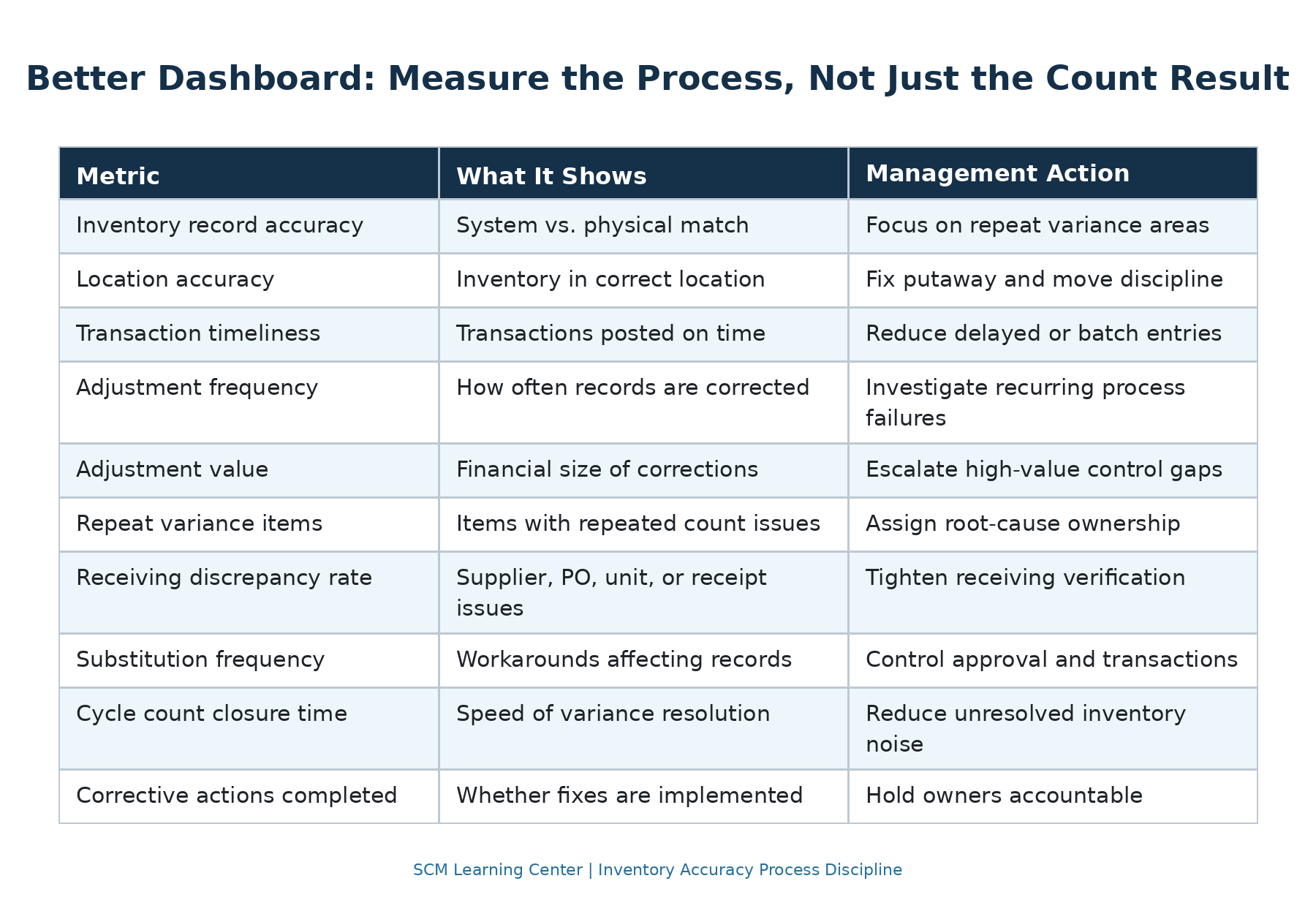
The strongest operations do not only ask, “What was the accuracy rate?”
They ask:
* Where are the errors being created?
* Which process step is creating repeat defects?
* Which items or locations keep failing?
* Which transactions are late, missing, or reversed?
* Which corrective actions actually reduced future variances?
That is how inventory accuracy becomes a management system.
Use these questions to assess whether your inventory accuracy issue is really a process discipline issue:
1. Are receiving transactions completed only after item, quantity, condition, lot, and unit of measure are verified?
2. Can inventory be physically moved without a matching system move?
3. Are employees able to transact inventory at the point of work?
4. Are substitutions formally approved and correctly recorded?
5. Are returns inspected and dispositioned before being returned to available inventory?
6. Are cycle count variances coded by likely cause?
7. Are repeat variances reviewed by process owner?
8. Are adjustments being used to correct records without correcting behavior?
9. Does each function understand its role in inventory accuracy?
10. Is inventory accuracy discussed as an operating discipline or only as a warehouse metric?
If most answers are weak, counting more will not solve the problem.
Week 1: Identify the Top Repeat Variance Items
Look for items with recurring count discrepancies, frequent adjustments, location mismatches, or repeated availability issues.
Do not start with every SKU. Start where the pain is visible.
Week 2: Trace the Process Path
Follow those items from receiving through storage, replenishment, production use, returns, substitutions, and shipment.
The goal is to find where system reality and physical reality separate.
Week 3: Classify the Defect Source
Separate the defects by likely source:
* Receiving defect
* Putaway defect
* Location move defect
* Production issue defect
* Return defect
* Substitution defect
* Unit of measure defect
* Adjustment control defect
* Ownership defect
This is where the organization moves from counting to learning.
Week 4: Assign Corrective Action Owners
Do not stop at the adjustment. Assign the process owner responsible for preventing recurrence.
A corrected record is useful.
A corrected process is valuable.
A regional distributor had recurring stockouts on high-volume service parts even though the system showed available inventory. The warehouse team was told to improve picking accuracy and increase cycle counts.
After a process review, the issue was traced to uncontrolled movement between reserve storage and forward pick locations. Supervisors were authorizing urgent moves to support shipping, but the moves were not always transacted immediately.
Cycle counts kept finding shortages in reserve and overages in pick locations.
The company changed three things:
1. Required system moves before replenishment pallets were released.
2. Added a reason code for emergency replenishment moves.
3. Reviewed move compliance by shift each week.
After several weeks, repeat variances on the same service parts declined, emergency replenishment moves became visible, and planners spent less time manually checking availability before releasing orders.
The solution was not just better counting.
The solution was better process discipline.
Inventory accuracy is not a warehouse clean-up project. It is an operating discipline.
Counting tells you whether the record is wrong. Process discipline determines whether the record stays right.
If your organization is fighting the same inventory variances every month, do not start by asking how often you should count. Start by asking where the process is allowing inventory reality and system reality to separate.
That is where the real improvement work begins.
1. ASCM — “What Is Inventory Management?”
2. ASCM — “8 KPIs for an Efficient Warehouse”
3. APICS Dictionary definition of cycle counting, as cited by APICS San Antonio Chapter article, “Cycle Counting by the Probabilities”
Jeffrey McDaniels
Founder & Chief Capability Officer
SCM Learning Center
www.scmlearningcenter.com
jbmac@scmlearningcenter.com